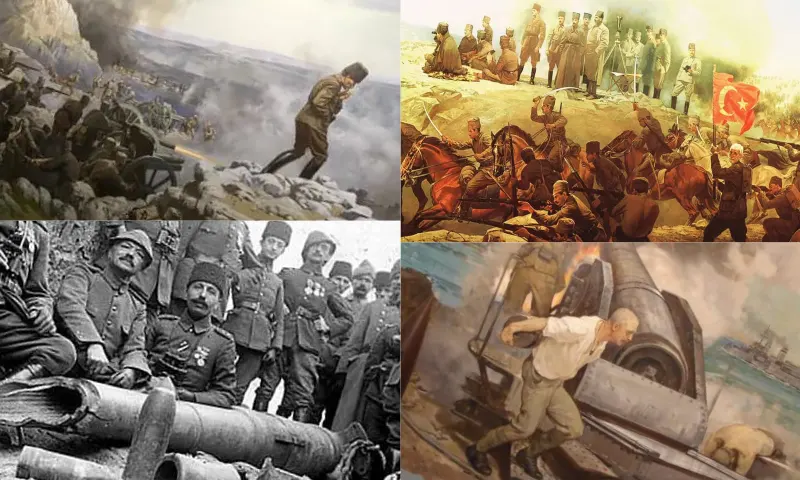
The Gallipoli Campaign, which took place in 1915 between the Ottoman Empire and the Allied Powers, is a war that holds a significant place in Turkish history. The important events and effects of this war, which shaped history, are still felt today. The Gallipoli Campaign was part of World War I. The Ottoman Empire joined Germany and the Austro-Hungarian Empire at the start of World War I. This led Britain, France, and Russia to take action against the Ottomans. The British aimed to capture the Dardanelles Strait and take Istanbul. For this purpose, the war began on February 19, 1915.
Development of the Gallipoli Campaign
The war began with the entry of the British and French navies into the Dardanelles Strait. However, the attacks from the sea were prevented in this region, where the Ottomans were prepared. The Allied Powers then wanted to attack by land. For this purpose, clashes occurred in Anafartalar and Seddülbahir. One of the most important events of the war was the Battle of Conkbayırı. In this battle, Turkish soldiers repelled the British and French troops and changed the course of the war. As a result, the Ottoman Empire won the Gallipoli Campaign.
Effects of the Gallipoli Campaign
The Gallipoli Campaign was an important event not only for the Ottoman Empire but for the entire world. The outcome of the war was that the Allied Powers could not pass through the Straits and Istanbul remained under Ottoman control. This situation led the Ottoman Empire to remain in World War I for a longer period. Furthermore, the victory in the Gallipoli Campaign demonstrated the courage and patriotism of Turkish soldiers to the whole world. For this reason, March 18 is celebrated every year as Gallipoli Victory and Martyrs Commemoration Day.